

For those working with plastics, using flame-retardant additives is often required to minimise the risk of fire spreading in the event of a fire.
In a previous article, we explained the difference between antistatic and flame-retardant additives, including how combustion works and the role that flame-retardant additives play in preventing it. Today, we’ll go into a bit more detail about the mechanisms of flame retardancy.
Do flame-retardant additives extinguish fires?
Let’s start with a fundamental premise: the purpose of flame retardants is to interrupt or slow down one or more stages of the combustion cycle (for example, by delaying ignition or reducing the rate of heat release), thereby limiting the spread of the flame. Ideally, a flame retardant would extinguish the flame, but the primary goal is to buy time to escape or take effective action to combat the fire.
Flame retardant additives can act during different phases (condensed, gaseous, heating or melting), so there is no single mechanism that applies to all additives, just as there is no single flame retardant suitable for all polymers. For this reason, product analysis and consultation with stakeholders in the production chain (compounders, moulders, etc.) are essential to identify the most suitable solution for each product.
The main flame-retardant mechanisms
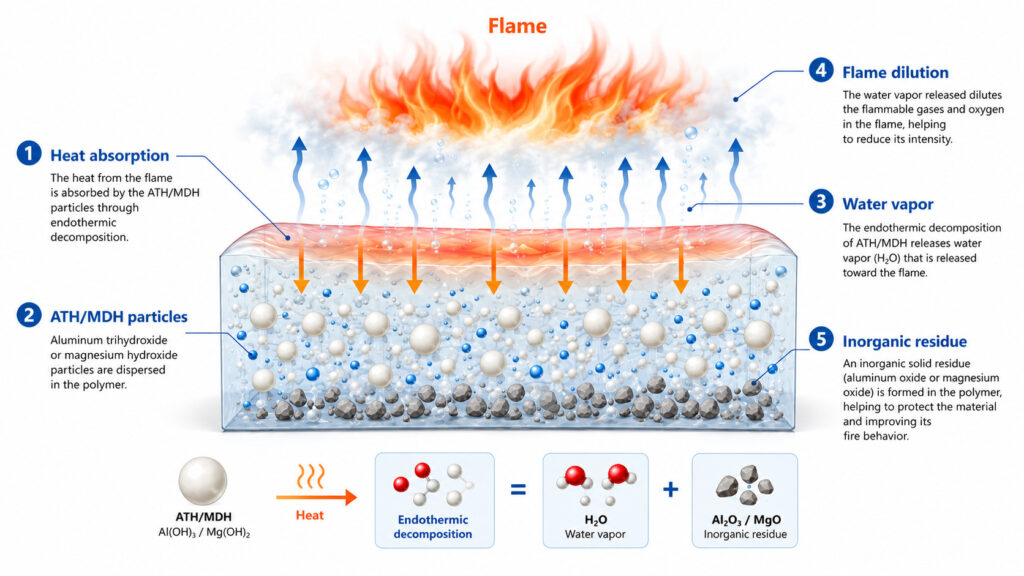
Water development
This first mechanism involves the use of inorganic hydroxides—the most commonly used are aluminum hydroxide, Al(OH)₃, and magnesium hydroxide, Mg(OH)₂—which decompose endothermically when heated, triggering a reaction that absorbs heat and releases water vapor. This results in:
- cooling, by removing heat from the polymer
- dilution of flammable gases and oxygen due to the water vapor
- formation of an inorganic residue that can help create a protective barrier.
Gas Phase
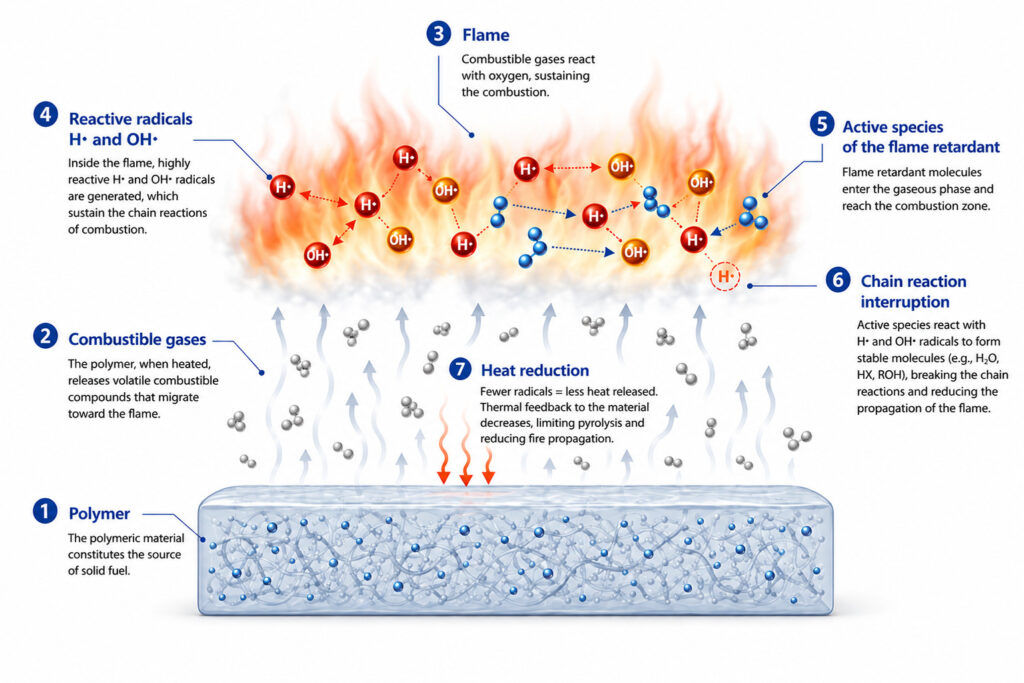
In this case, the additives act on the radicals that propagate combustion—such as hydrogen, oxygen, and hydroxyl—during the gas phase. Brominated compounds or phosphorus-based additives can be used for this purpose. We can summarize the differences between the two categories in simplified terms as follows:
Char formation
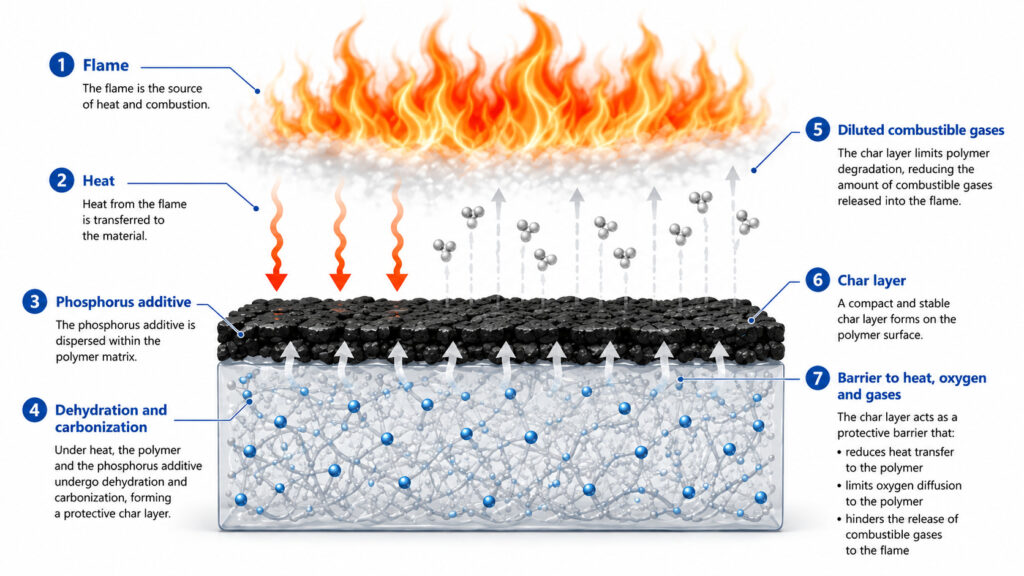
This mechanism is facilitated by carbonising additives, which stabilize the carbon in the polymer and create a protective barrier (char) that physically isolates the heat source from its surface.
This reduces the release of combustible substances into the atmosphere, as well as the flow of oxygen into the polymer.
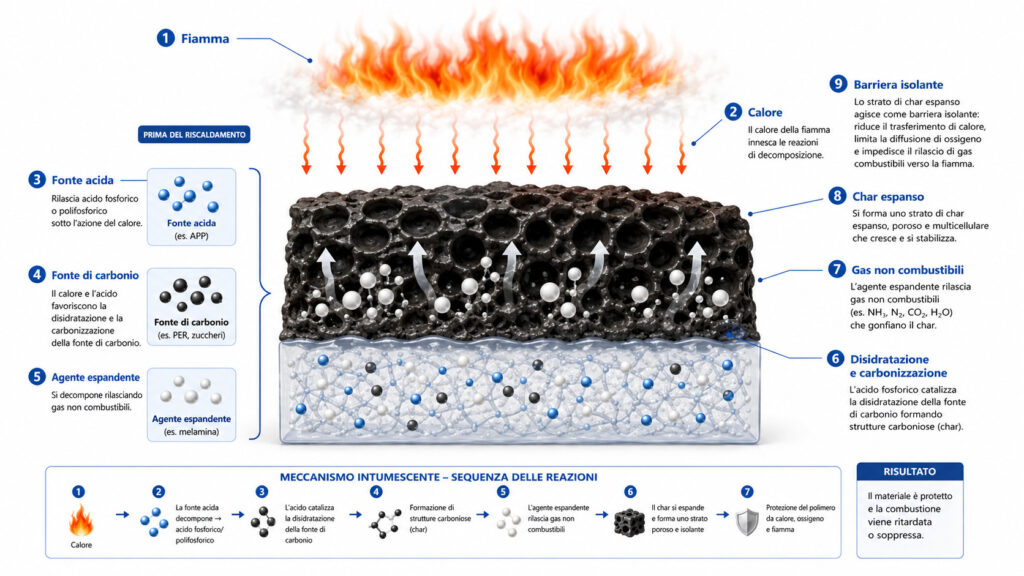
Intumescent mechanism
Similar to the previous one, in which a layer of char also forms, is the intumescent mechanism. When heated, the system expands and forms a carbonized, porous, multicellular layer characterized by low thermal conductivity. In this case, chemical and physical actions combine to significantly reduce heat release and flame spread.
Dripping mechanism
Finally, there is the dripping mechanism. Unlike previous mechanisms, which act on the flame or the polymer surface, the dripping additive chemically interacts with the polymeric material to promote the dripping of molten material.
During combustion, the flame retardant breaks the polymer chains, making them shorter and promoting the removal of the molten material. This removes heat and fuel from the affected area.
To summarize, a flame retardant works by disrupting the link between fuel production, flame chemistry, and heat transfer. The right flame retardant must be selected on a case-by-case basis, taking into account the polymer’s structure, processing conditions, mechanical properties and, last but not least, environmental and regulatory requirements.
That’s why we invite you to contact us so we can discuss your product’s specific needs together: just send an email to salesteam@greenchemicals.green! 😊
If you’d like to learn more about our flame retardants in the meantime, click here:
FLAME RETARDANT – HALOGEN-FREE FR
For a quick summary, here is a table comparing the various mechanisms that explain how flame retardants for plastics work.