

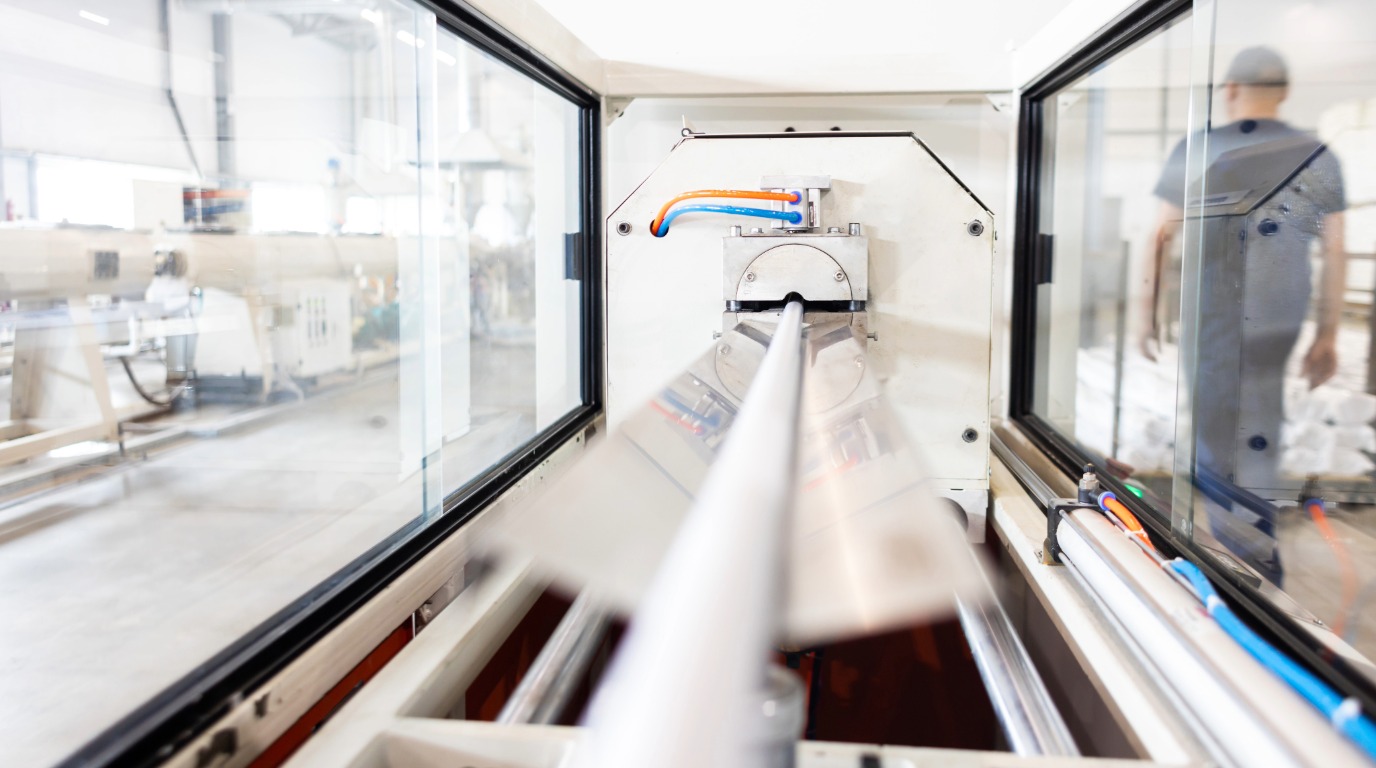
Extrusion is one of the most widely used processing methods in the plastics industry: it enables thermoplastic materials to be processed continuously, making profiles, pipes, sheets, films and much more. It must be emphasised, however, that the quality of the final product and the efficiency of the process itself depend to a significant extent on the additives added to the polymer.
Choosing the right additives does not simply mean ‘improving’ a material but defining what that material will be capable of doing, in what context, and for how long.
Matching additives to applications
Thermoplastic polymers in their basic form are neutral materials: colourless, with no resistance to heat, light, or flame, and with mechanical properties that may be insufficient for many applications. It is possible to modify their aesthetic, mechanical, thermal, electrical and safety characteristics by selecting the right additive, thereby making the same base polymer suitable for a wide variety of applications.
Among the most used additives in extrusion are processing aids, thermal and UV stabilisers, nucleating agents and flame retardants. However, there is no one-size-fits-all answer to the question ‘which additives should be used?’: it depends on the type of polymer and, above all, on the end application.
Let’s take two concrete examples. An indoor ABS electrical box, such as that used in a burglar alarm system, requires a relatively simple formulation: flame retardants, thermal stabilisers and light stabilisers are often sufficient to achieve a high-quality end product. An electrical switchboard, on the other hand, is a different matter: it is a component that must withstand impact, provide electrical insulation, maintain dimensional stability over time and meet stringent requirements in terms of resistance to heat, abrasion and laser marking. In this case, engineering polymers and a more complex additive system (flame retardants, nucleating agents, thermal stabilisers, colourants, stabilisers) are required, as each element contributes to improving the component’s overall performance.
This approach applies to any application: first, the end use is defined; then, the formulation is developed.
Greenchemicals additives for thermoplastic extrusion
We develop additive solutions for the plastics industry with an application-focused approach, using formulations designed to meet specific process and product requirements.
A key strength of our product range is our flame retardants, which enable products to meet fire resistance requirements in accordance with various industry standards. Alongside this product category – which is the most popular choice amongst our customers – our product range is broad: antioxidants, UV stabilisers, nucleating agents, chain extenders, stabilisers, processing aids and much more.
Would you like to find the solution best suited to your application? Contact us: our technical team is on hand to analyse your requirements and identify the most effective formulation.